Model Tracking
The astrodata.tracking module provides capabilities for experiment tracking, primarily through integration with MLflow. This allows users to log model parameters, metrics, artifacts, and manage different versions of their machine learning models.
Abstract Classes
ModelTracker is the abstract base class that all model trackers should inherit from. It defines the fundamental methods that a model tracker object must implement:
wrap_fit(BaseMlModel): Takes as input a model and returns the same model with itsfitmethod now able to log the model to the required service.
How to Use
Initializing a tracker
How a tracker is initialized depends on the tracker implementation. Once a tracker is initialized, all that’s needed is to call its wrap_fit() method with an already initialized model as argument to get the same model with the wrapped fit() method as output. Once this is done you can proceed by using the model as usual.
from astrodata.tracking.ModelTracker import ModelTracker
from astrodata.ml.models.BaseMlModel import BaseMlModel

model = BaseMlModel( ... )
tracker = ModelTracker( ... )

tracked_model = tracker.wrap_fit(model)

tracked_model.fit(X_train, y_train)
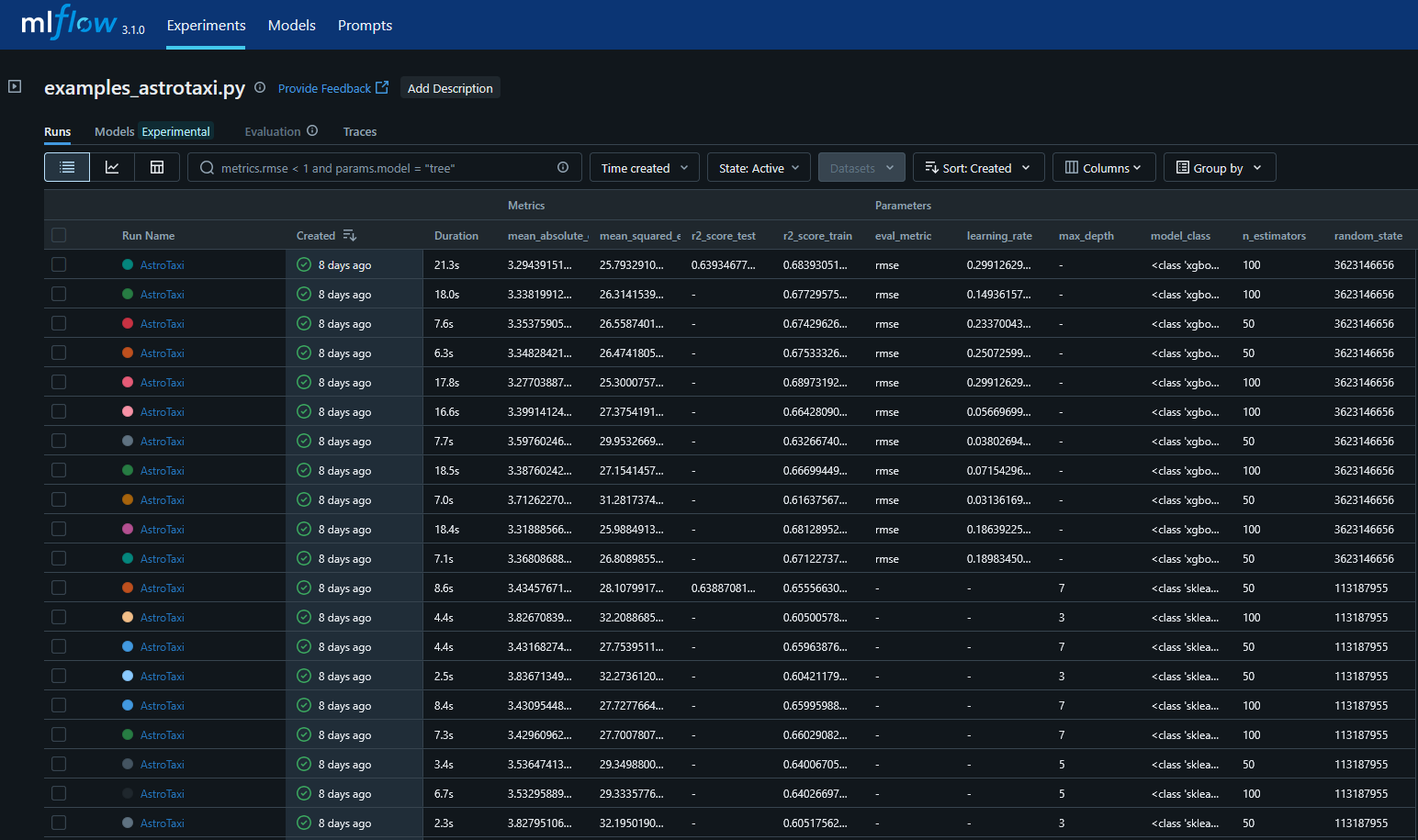
Whenever you call the .fit method of the model after wrapping it, the tracker will handle logging it to its own service; when using an MlFlowTracker for example, the logs are either stored locally or in an external server whenever the model is fitted, each run represent a call of the .fit method and it containes the information of the logged metrics, the model’s parameters and any artifact (the model files) that may be stored. Different services store different things, but as the most used open source ml-ops application, astrodata implements MlFlow by default.
MlflowBaseTracker
MlflowBaseTracker is the base class for MLflow integration with astrodata. It provides common MLflow configuration and tracking functionality that framework-specific trackers (such as SklearnMLflowTracker, PytorchMLflowTracker, and TensorflowMLflowTracker) inherit from. This class does not implement the wrap_fit() method directly, but provides all the necessary infrastructure for connecting to and using an MLflow tracking server.
Note
You should use the framework-specific tracker classes (SklearnMLflowTracker, PytorchMLflowTracker, TensorflowMLflowTracker) rather than MlflowBaseTracker directly.
Parameters
run_name : str, optional
Name for MLflow run.
experiment_name : str, optional
Name of the MLflow experiment.
extra_tags : dict, optional
Extra tags to log with the run.
tracking_uri : str, optional
MLflow tracking server URI.
tracking_username : str, optional
Username for authentication (if needed).
tracking_password : str, optional
Password for authentication (if needed).
SklearnMLflowTracker
This class extends MlflowBaseTracker to provide MLflow tracking for scikit-learn compatible models. It wraps the model’s fit() method to automatically log parameters, metrics, and optionally the trained model to MLflow.
Attention
XGBoostModel is scikit-learn compatible and uses the same tracker!
SklearnMLflowTracker.wrap_fit() parameters
model : BaseMlModel
The model to wrap.
X_test : array-like, optional
Test data for metric logging.
y_test : array-like, optional
Test labels for metric logging.
X_val : array-like, optional
Validation data for metric logging.
y_val : array-like, optional
Validation labels for metric logging.
metrics : list of BaseMetric, optional
Metrics to log. If missing, a default loss metric is added.
log_model : bool, default False
If True, log the fitted model as an MLflow artifact.
tags: Dict[str, Any], default {}
Any additional tags that should be added to the model. By default, the tag “is_final” is set equal to
log_model.
manual_metrics : Tuple[Dict[str, Any], str], optional
Manual metrics to log with a split name.
run_name : str, optional
Name for the MLflow run. If None, uses tracker’s run_name.
Example wrap_fit() usage
When calling the wrap_fit() method on an existing model, some parameters are passed to allow for correct metrics computation such as a metrics array (which logs the model loss by default), data to test on (either X_val/y_val or X_test/y_test), and any additional tag that we want to add while logging the model.
from sklearn.ensemble import GradientBoostingClassifier
from astrodata.ml.models.SklearnModel import SklearnModel
from astrodata.tracking.MLFlowTracker import SklearnMLflowTracker

gradientboost = SklearnModel(model_class=GradientBoostingClassifier)

tracker = SklearnMLflowTracker(
        run_name="MlFlowSimpleRun",
        experiment_name="simple_example",
        extra_tags={"stage": "testing"},
    )

tracked_gradientboost = tracker.wrap_fit(
        gradientboost, X_test=X_test, y_test=y_test, metrics=metrics, log_model=True
    )

tracked_gradientboost.fit(X_train, y_train)
PytorchMLflowTracker
This class extends MlflowBaseTracker to provide MLflow tracking for PyTorch models. It wraps the PytorchModel fit() method to automatically log parameters, metrics, training history, and optionally the trained model to MLflow.
PytorchMLflowTracker.wrap_fit() parameters
model : PytorchModel
The PyTorch model to wrap.
X_test : array-like, optional
Test data for metric logging.
y_test : array-like, optional
Test labels for metric logging.
X_val : array-like, optional
Validation data for metric logging.
y_val : array-like, optional
Validation labels for metric logging.
dataset_test : torch.utils.data.Dataset, optional
Test dataset for metric logging.
dataset_val : torch.utils.data.Dataset, optional
Validation dataset for metric logging.
metrics : list of BaseMetric, optional
Metrics to log during training and evaluation.
log_model : bool, default False
If True, log the fitted PyTorch model as an MLflow artifact.
tags: Dict[str, Any], default {}
Any additional tags to add to the run. By default, “is_final” is set equal to
log_model.
manual_metrics : Tuple[Dict[str, Any], str], optional
Manual metrics to log with a split name.
run_name : str, optional
Name for the MLflow run. If None, uses tracker’s run_name.
Example Usage
import torch.nn as nn
import torch.optim as optim
from astrodata.ml.models import PytorchModel
from astrodata.tracking.MLFlowTracker import PytorchMLflowTracker
from astrodata.ml.metrics import SklearnMetric
from sklearn.metrics import accuracy_score

# Define a simple PyTorch model
class SimpleNet(nn.Module):
    def __init__(self, input_dim, hidden_dim, output_dim):
        super().__init__()
        self.fc1 = nn.Linear(input_dim, hidden_dim)
        self.relu = nn.ReLU()
        self.fc2 = nn.Linear(hidden_dim, output_dim)

    def forward(self, x):
        x = self.fc1(x)
        x = self.relu(x)
        return self.fc2(x)

# Initialize the model
model = PytorchModel(
    model_class=SimpleNet,
    model_params={"input_dim": 10, "hidden_dim": 64, "output_dim": 2},
    loss_fn=nn.CrossEntropyLoss,
    optimizer=optim.Adam,
    optimizer_params={"lr": 0.001},
    epochs=10,
    batch_size=32
)

# Set up tracking
tracker = PytorchMLflowTracker(
    run_name="pytorch_experiment",
    experiment_name="pytorch_tracking_example",
    extra_tags={"model_type": "SimpleNet"}
)

metrics = [SklearnMetric(accuracy_score)]

tracked_model = tracker.wrap_fit(
    model,
    X_test=X_test,
    y_test=y_test,
    metrics=metrics,
    log_model=True
)

tracked_model.fit(X_train, y_train)
TensorflowMLflowTracker
This class extends MlflowBaseTracker to provide MLflow tracking for TensorFlow/Keras models. It wraps the TensorflowModel fit() method to automatically log parameters, metrics, training history, and optionally the trained model to MLflow.
TensorflowMLflowTracker.wrap_fit() parameters
model : TensorflowModel
The TensorFlow/Keras model to wrap.
X_test : array-like, optional
Test data for metric logging.
y_test : array-like, optional
Test labels for metric logging.
X_val : array-like, optional
Validation data for metric logging.
y_val : array-like, optional
Validation labels for metric logging.
dataset_test : tf.data.Dataset, optional
Test dataset for metric logging.
dataset_val : tf.data.Dataset, optional
Validation dataset for metric logging.
metrics : list of BaseMetric, optional
Metrics to log during training and evaluation.
log_model : bool, default False
If True, log the fitted TensorFlow model as an MLflow artifact.
tags: Dict[str, Any], default {}
Any additional tags to add to the run. By default, “is_final” is set equal to
log_model.
manual_metrics : Tuple[Dict[str, Any], str], optional
Manual metrics to log with a split name.
run_name : str, optional
Name for the MLflow run. If None, uses tracker’s run_name.
Example Usage
import keras as K
from astrodata.ml.models import TensorflowModel
from astrodata.tracking.MLFlowTracker import TensorflowMLflowTracker
from astrodata.ml.metrics import SklearnMetric
from sklearn.metrics import accuracy_score

# Define a simple Keras model
def build_model(input_dim, hidden_dim, output_dim):
    model = K.Sequential([
        K.layers.Dense(hidden_dim, activation='relu', input_shape=(input_dim,)),
        K.layers.Dense(output_dim, activation='softmax')
    ])
    return model

# Initialize the model
model = TensorflowModel(
    model_class=build_model,
    model_params={"input_dim": 10, "hidden_dim": 64, "output_dim": 2},
    loss_fn=K.losses.SparseCategoricalCrossentropy,
    optimizer=K.optimizers.Adam,
    optimizer_params={"learning_rate": 0.001},
    epochs=10,
    batch_size=32
)

# Set up tracking
tracker = TensorflowMLflowTracker(
    run_name="tensorflow_experiment",
    experiment_name="tensorflow_tracking_example",
    extra_tags={"model_type": "SequentialNN"}
)

metrics = [SklearnMetric(accuracy_score)]

tracked_model = tracker.wrap_fit(
    model,
    X_test=X_test,
    y_test=y_test,
    metrics=metrics,
    log_model=True
)

tracked_model.fit(X_train, y_train)
register_best_model()
All MLflow tracker classes inherit the register_best_model() method from MlflowBaseTracker. This method allows you to register the best model from an experiment to the MLflow Model Registry based on a specific metric.
Parameters
metric : BaseMetric
Metric used to select the best run.
registered_model_name : str, optional
Name for the registered model. Defaults to experiment name.
split_name : str, default “train”
Which split’s metric to use (‘train’, ‘val’, or ‘test’).
stage : str, default “Production”
Model stage to assign (e.g., ‘Production’, ‘Staging’).
Example
from astrodata.ml.metrics import SklearnMetric
from sklearn.metrics import accuracy_score

# After running multiple experiments
accuracy_metric = SklearnMetric(accuracy_score)
tracker.register_best_model(
    metric=accuracy_metric,
    registered_model_name="best_classifier",
    split_name="test",
    stage="Production"
)